
Should You Weigh Food Raw or Cooked?
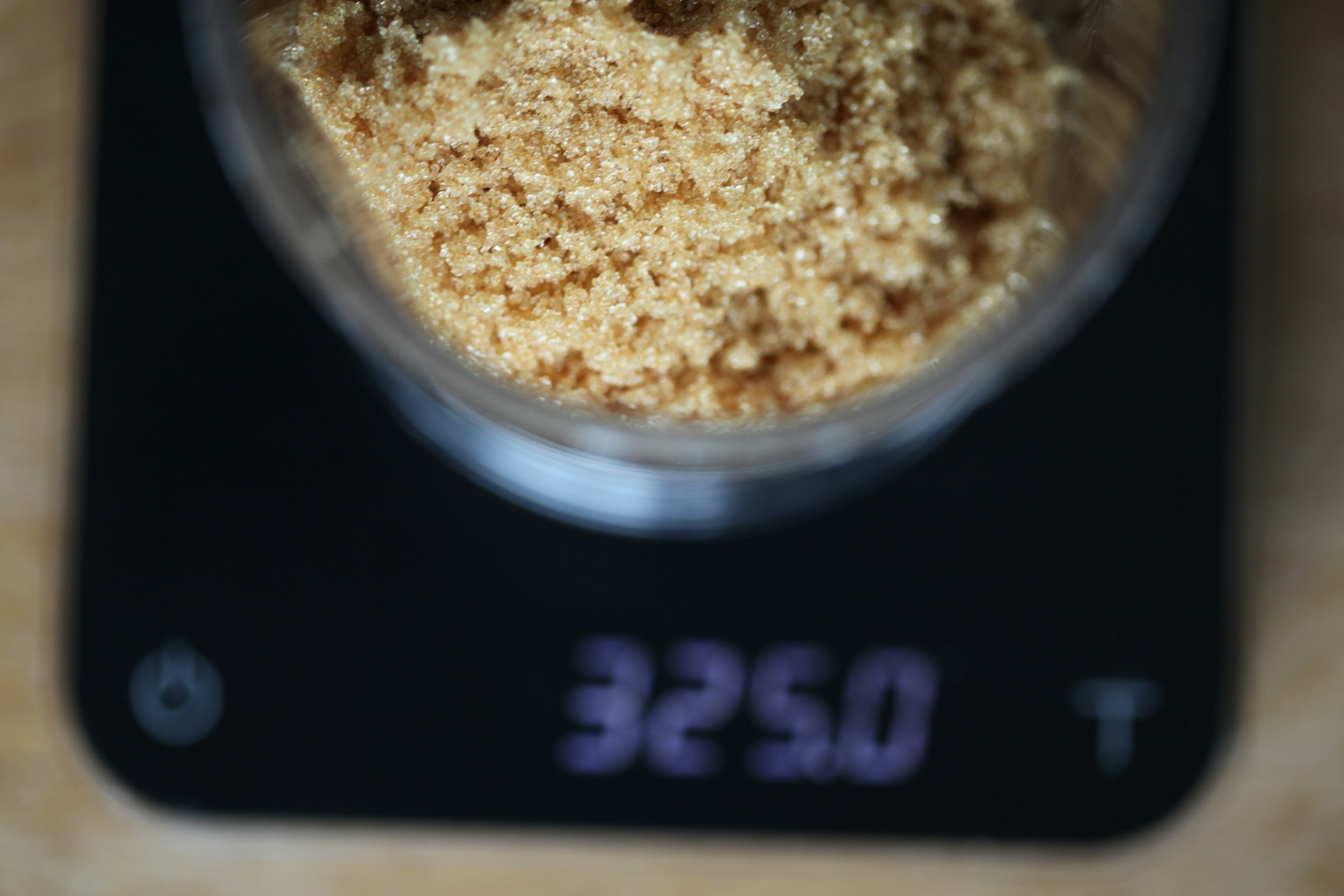
Either one works, as long as the weight on your scale and the database entry you log against describe the same thing. Cooking moves water into rice and pasta and out of meat, so the calories per 100g shift a long way. Weighing raw or dry is the easier habit, because that is what the packet declares.
Get the two halves out of step and the error is large. Two hundred grams of cooked rice logged against a dry rice entry comes out at about 730 calories instead of about 260.
In brief
- USDA FoodData Central lists white long grain rice at 365 kcal per 100g dry and 130 kcal per 100g boiled, so the same word covers two very different numbers.
- Meat runs the other way. USDA puts skinless chicken breast at 120 kcal per 100g raw and 151 kcal per 100g grilled.
- US rules require the figures on a packet to be for the food as packaged, so if there is only one set of numbers, they are the uncooked ones.
- Match the state you weighed to the state of the entry. A cooked weight against a cooked entry is fine, a cooked weight against a dry entry is the mistake.
- UK rules are looser, values must be for the food as sold, but a pack carrying detailed preparation instructions may give the prepared figures instead, so the wording matters.
- If you brown fatty mince and pour the fat off, the raw weight stops describing your dinner, and the cooked entry is the closer match.
Why the two numbers are so far apart
Most of it is water. USDA FoodData Central lists dry white rice at 11.6g of water per 100g. Boiled, the same rice is 68.4g of water per 100g. The starch and protein have not multiplied. They are spread through a lot more water, so any given 100g of cooked rice holds less of them. Boiling and draining sends a little starch down the sink too. Grilling a chicken breast runs the process backwards, driving water off so that what stays behind is more concentrated. Some fat and juice goes with the water, so the cooked figure carries a small loss as well as the concentration.
How far the weight moves depends on how you cooked it, which is why we would not want to put a single conversion number on it. Rice simmered with a lid on and rice boiled and drained do not end up at the same weight.
How big is the difference?
| Food | Raw or dry | Cooked | How it was cooked |
|---|---|---|---|
| White rice, long grain | 365 kcal | 130 kcal | Boiled, no salt |
| Pasta | 371 kcal | 158 kcal | Boiled, no salt |
| Chicken breast, skinless | 120 kcal | 151 kcal | Grilled |
| Beef mince, 80% lean (20% fat) | 254 kcal | 272 kcal | Pan browned |
Energy per 100g, from USDA FoodData Central (SR Legacy). The rice and pasta records are the unenriched ones. These are US reference figures, and the closest UK equivalent to 80% lean mince is a pack labelled 20% fat, though the two conventions are not defined identically, so treat that as the nearest match rather than the same specification.
SR Legacy is a historical dataset, released in its final form in April 2018 and no longer updated, with the rice entries dated 1989. And each pair comes from separate samples rather than the same batch cooked and measured twice, so read them as reference values for the gap rather than as a precise conversion.
What is the packet telling you?
Both the UK and the US start from the same rule and then part company on one point that decides what you can assume.
In the US, FDA rules require the declaration for packaged food to be “on the basis of food as packaged or purchased”, and separately allow a manufacturer to present two forms of the same food, such as “as purchased” and “as prepared”. So a US pack showing one set of numbers is generally describing the uncooked food, with cooked figures arriving as a second column. There are carve-outs written into the same paragraph, including single-ingredient fish and game meat, which can be declared cooked in a single column. Raw meat and poultry fall under a different agency’s labelling rules again.
The UK rule gives more room. Values must be those of the food as sold, but where a pack carries sufficiently detailed preparation instructions, the information may relate to the food as prepared instead. One column on a UK pack is therefore not proof on its own, so the heading above the table is worth reading rather than assuming.
Either way it is a clearer answer than nutrition labels usually give you.
What if the entry does not say?
A barcode scan at least points at one specific product, though the databases behind those scans are crowd-sourced too. Free text search is where it gets properly murky, and you end up with a list of entries called “rice” with nothing to say which state any of them means.
For plain boiled staples the number itself is a reasonable clue. In the USDA figures above, dry rice and pasta sit around 365 to 371 kcal per 100g while the boiled versions come in around 130 to 158, so an entry up near 350 is describing the dry food and one down near 150 is describing the cooked.
That check has real limits. Porridge lands well below the cooked band, anything fried or sauced lands above it, most instant noodles are fried before they reach you and run far higher than ordinary dry pasta, and plenty of crowd-sourced entries are per serving or per cup rather than per 100g, which breaks the comparison entirely. It does not work on meat at all: 120 against 151 for chicken breast is a smaller gap than the spread between cuts and trim levels, so there is nothing to eyeball.
Where the rule flips
Weigh raw or dry wherever the choice is yours. Weigh the pasta before it goes in the pan, put the bowl on the scale and zero it first, and log against an entry that says raw or dry. It matches the packet and it does not depend on how long you cooked something. Whatever oil went into the pan is a separate line in your log, and it is the easiest thing here to forget.
Fatty mince is the one place this can break down, and only if you pour the fat off. Browning mince drives off water and renders fat. Tip that fat away and a real share of the calories has gone down the sink, so the raw weight describes food you did not eat and a cooked entry is the closer match, albeit one that has no idea how much you poured away. Leave the fat in, as most people do when it is heading into a bolognese or a chilli, and it is still your dinner, so the raw weight was right all along.
You will also lose the choice fairly often. Someone else cooked, or it is leftovers, or you are eating out, where the numbers are loose anyway. Use a cooked entry and accept a wider margin.
Does this matter if you are gaining weight?
The mechanism is the same either way, but the cost lands differently.
Log cooked rice against a dry entry and your total comes out far too high. In a deficit, your log tells you that you have eaten more than you have, so you cut back further than you meant to. In a surplus, the same inflated figure convinces you that you have hit your target when you have not, so you stop short and gain more slowly than you planned. Weighing dry and logging against a cooked entry goes the other way: 100g of dry rice logged as cooked comes out at 130 calories rather than 365. Both mistakes are large.
None of this is a reason to weigh more carefully than you want to. It is a reason to treat any day’s total as an estimate. That is the assumption Ori is built on: it takes your logs as the approximations they are and adjusts your guidance from what your weight does over the following weeks. If you would rather describe a meal in a sentence than weigh it, say whether it was cooked and the state has gone in with it.
Have a look at Ori if that sounds like your kind of trade-off.
Sources
- Rice, white, long-grain, regular, raw, unenriched, USDA FoodData Central SR Legacy 169756 — 365 kcal and 11.6g water per 100g
- Rice, white, long-grain, regular, unenriched, cooked without salt, USDA FoodData Central SR Legacy 169757 — 130 kcal and 68.4g water per 100g
- Pasta, dry, unenriched, USDA FoodData Central SR Legacy 168927 — 371 kcal and 9.9g water per 100g
- Pasta, cooked, unenriched, without added salt, USDA FoodData Central SR Legacy 168928 — 158 kcal and 62.1g water per 100g
- Chicken, broiler or fryers, breast, skinless, boneless, meat only, raw, USDA FoodData Central SR Legacy 171077 — 120 kcal and 73.9g water per 100g
- Chicken, broiler or fryers, breast, skinless, boneless, meat only, cooked, grilled, USDA FoodData Central SR Legacy 171534 — 151 kcal and 66.1g water per 100g
- Beef, ground, 80% lean meat / 20% fat, raw, USDA FoodData Central SR Legacy 174036 — 254 kcal per 100g
- Beef, ground, 80% lean meat / 20% fat, crumbles, cooked, pan-browned, USDA FoodData Central SR Legacy 171799 — 272 kcal per 100g
- 21 CFR 101.9, Nutrition labeling of food, eCFR — paragraph (b)(9) requires declaration on the basis of food as packaged or purchased; paragraph (e) allows two forms of the same food to be presented
- Regulation (EU) No 1169/2011, Article 31, as retained in UK law, legislation.gov.uk — paragraph 3: values shall be those of the food as sold, and may relate to the food after preparation where sufficiently detailed preparation instructions are given
Related reading
- Do You Need to Weigh Food to Count Calories? — whether the scale earns its place at all
- Why Are Nutrition Labels So Confusing? — the arithmetic the packet asks of you
- Are Restaurant Calorie Counts Accurate? — when you never see the raw weight
A gentle safety note
Ori supports general wellness. It is not medical care. If you have a history of disordered eating, are pregnant or breastfeeding, take medicines that affect weight or appetite, or have a clinical nutrition need, speak with a qualified healthcare professional before changing your intake or weight goal.
Read Ori's Health Disclaimer