
Do You Need to Weigh Food to Count Calories?
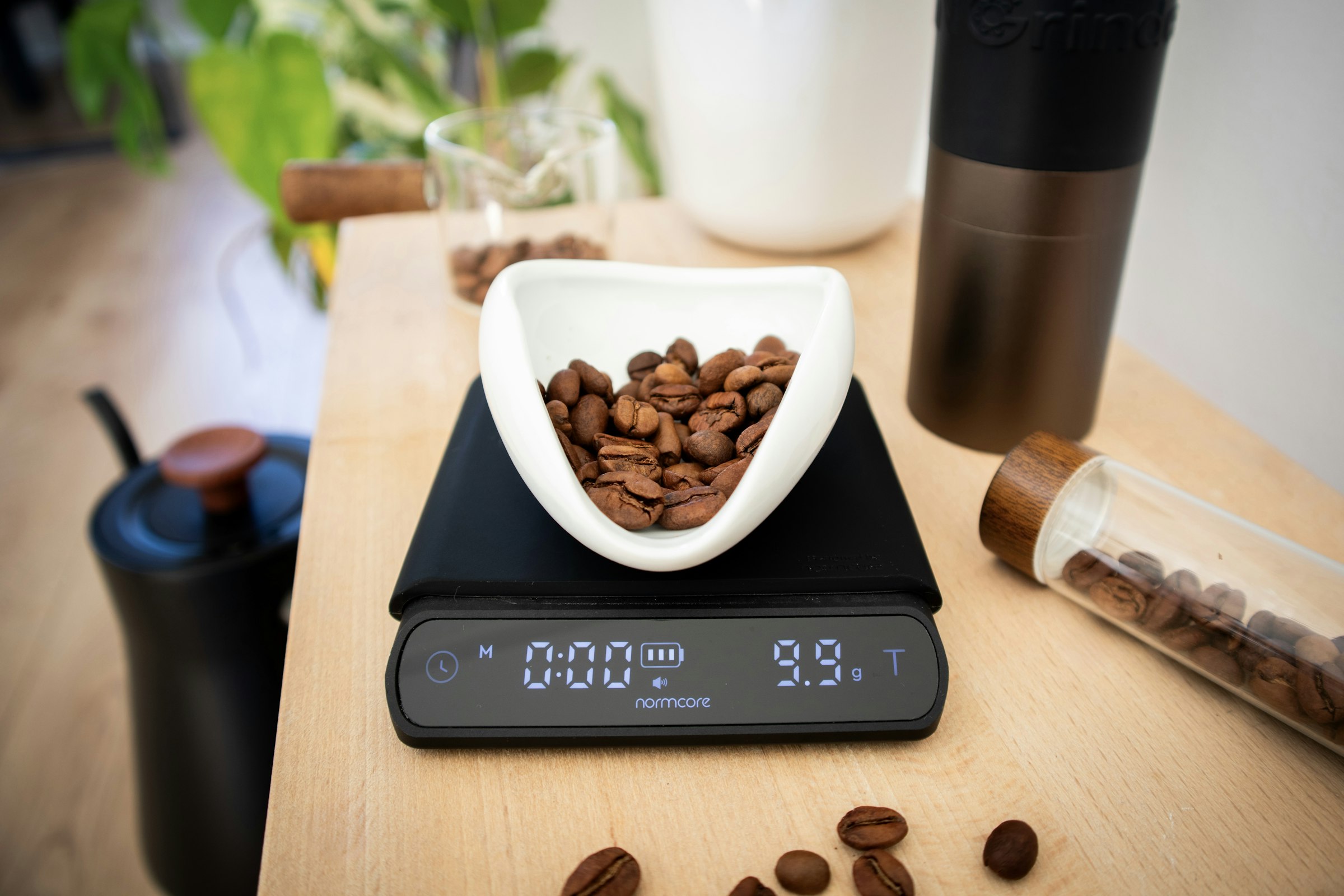
Weighing your food makes calorie tracking more accurate for the portion-size part of the estimate, and only for some foods. In a 2021 Wageningen University study of 40 adults describing what they ate in words, single items like bread slices were judged within 10% of their true weight 95% of the time, and loose foods like muesli and yoghurt only 12% of the time. Weigh those few; eyeball the rest.
In brief
- In that 2021 study of 40 adults, 31% of portion estimates landed within 10% of the true weight and half landed within 25%.
- Accuracy depended almost entirely on the food: describing portions in words, 95% for single items against 12% for loose, shapeless ones.
- Weighing fixes portion error. It does nothing about label error, database error or forgotten food.
- Two trials comparing detailed calorie logging with a simpler alternative disagree with each other, so treat "precision doesn't matter" as unproven.
Does weighing your food make calorie tracking more accurate?
Yes, for the portion part of it. How much that’s worth depends on what you’re eating, and there’s a good study that shows why.
Researchers at Wageningen University in the Netherlands gave 40 adults a real lunch, served from unlabelled containers with a choice of tableware. Everything was weighed before and after, so the team knew exactly what each person had eaten. Two hours later, and again at 24 hours, the participants reported their portions — either with household measures and text descriptions, or by picking the closest photograph.
Desiree Lucassen and colleagues published the results in the Journal of Human Nutrition and Dietetics in 2021. Using text and household measures, 31% of reported portions fell within 10% of the true weight, and half fell within 25%. Picking from photographs did worse: 13% within 10%, and 35% within 25%.
One caveat before reading too much into those numbers: participants were reporting from memory, two and twenty-four hours after eating. If you log at the table with the food still in front of you, your conditions are easier than theirs, so treat these as closer to a worst case than an everyday one. The study didn’t test logging at the table, so that’s our inference, not its finding.
Weighing food vs eyeballing portions: how wrong are people?
The errors weren’t spread evenly across the meal, and that’s what changes the answer.
| Food type | Examples from the study | Within 10% using text and household measures | Within 10% using photographs |
|---|---|---|---|
| Single items | Bread slices, bread rolls | 95% | 29% |
| Liquids | Milk, orange juice, water | 30% | 5% |
| Loose, shapeless foods | Yoghurt, muesli, cheese, scrambled egg, fruit salad | 12% | 13% |
| Spreads | Jam, margarine | 9% | 9% |
Source: Lucassen et al., 2021. Both reporting methods shown, because they don’t agree.
To put the spread in everyday terms: a 25% error on a 600-calorie meal is 150 calories, and half of all estimates in that study were further out than 25%.
Single items were judged well when people described them in words, which makes sense: two slices of bread is two slices of bread, and the packet tells you what a slice weighs. Loose foods have no natural unit. A “bowl” of muesli is whatever your bowl happens to be.
Note the photo column. Picking a matching picture was markedly worse for single items and liquids than simply saying “two slices” or “a large glass”. If you log by photo — including in Ori — a written description is the more accurate option when you have both, and worth choosing for the foods in that first row.
Do you weigh food raw or cooked?
Whichever the database entry says. Most nutrition databases list both, and the two are not interchangeable: rice and pasta take on water as they cook, meat loses it. Uncooked rice runs to roughly three times the calories per 100g of cooked rice, so weighing cooked rice against a raw-rice entry will overstate what you ate by about that much.
The practical version: weigh dry goods before cooking and match them to the raw entry, since that number is stable. And zero the scale with the bowl on it before you start, rather than doing arithmetic afterwards.
Do you need to weigh your food if you’re gaining?
The mechanism is the same, but it costs you differently, and this is worth spelling out because almost all writing on portion accuracy assumes you want to eat less.
The Lucassen paper notes a long-documented pattern known as the flat-slope phenomenon: large portions tend to be underestimated and small ones overestimated. Underestimating a large portion means your log says you ate less than you did.
If you’re eating in a deficit, that quietly shrinks the deficit — your log looks fine while progress stalls. If you’re eating in a surplus, the same error points the other way: your log says you’re short of target, so you add more food, and you can end up gaining faster than you meant to.
What does weighing not fix?
Suppose you weigh everything to the gram. Your portion figure is now close to exact. The calorie total still isn’t, because the portion is only the first number in the sum.
Take packaged food. Reiner Jumpertz and colleagues bought 24 popular packaged snacks in the United States and burned them in a bomb calorimeter to measure what was in them. Writing in Obesity in 2013, they found the measured calories ran a median of 6.8 kcal per serving, or 4.3%, above the label — with most products sitting inside the 20% margin the FDA allows. The serving-size weights printed on the packets were close too, a median of 1.2% off.
So for packaged snacks, both layers are small. Weighing the portion tightens an error that was barely there, and packet labels turn out more accurate than their reputation suggests.
The larger gaps sit elsewhere, and we’ve written about two of them separately: restaurant meals, where stated figures drift much further than packet labels do, and the gap between what people remember eating and what they ate. A scale reaches neither.
Does the extra precision change the result?
As far as we know, nobody has run the study we’d really want — weighed portions against eyeballed ones, same app, same people, measured to weight change. Two trials have tested something adjacent: detailed calorie logging against a deliberately simpler alternative. They disagree, and the disagreement is the useful part.
The larger and longer of the two was run by Brooke Nezami and colleagues at the University of North Carolina and published in Obesity in 2022. Seventy-two parents of young children were randomised for six months either to track calories or to log only high-calorie “red” foods against a daily limit. Weight loss was 5.7% in the calorie-tracking group and 4.0% in the simplified group — a gap that wasn’t statistically significant, in a pilot powered to detect a 2% difference. The trial found no difference between the groups in the number of days people tracked, and tracking days predicted weight loss only in the calorie-tracking group. Asked afterwards, the calorie trackers were more likely to say they’d keep the habit up.
The smaller trial, run by Michele Patel and colleagues at Stanford and published in JMIR Formative Research the same year, pointed differently. Thirty-eight US adults from racial and ethnic minority groups were randomised for three months. There the detailed group logged food on a median of 49% of days against 97% for the checklist group, with weight change of −3.4 kg and −3.3 kg respectively. Those authors deliberately did not test their arms against each other, because the study wasn’t built for it — so that adherence gap is a reported difference, not a tested one.
So: one trial found a large adherence gap and one found none. Both are small pilots with narrow samples — Nezami’s participants were mostly white, highly educated women; Patel’s were 84% women from minority groups in one US region. Neither shows the approaches are equivalent, and if anything the larger and longer of the two leans slightly towards detailed tracking for the people who keep it up.
There’s a broader counterweight worth stating plainly. A 2011 systematic review by Lora Burke and colleagues found a consistent association between self-monitoring and weight loss — while noting in the same breath that the level of evidence was weak because of methodological limitations in the studies reviewed, most of which predate smartphone apps entirely. Association, weakly evidenced, and it can’t separate “tracked more precisely” from “was more invested in the whole thing”.
What none of this supports is the comfortable conclusion that precision doesn’t matter. The honest summary is that detail probably helps the people who sustain it, and sustaining it is the part that reliably goes wrong. We’ve looked at that in why calorie counting goes wrong for some people, which also covers the research linking heavy calorie-tracking with disordered-eating symptoms in some people — relevant if you’re weighing up whether to put food on a scale at all.
So, do you need to weigh your food?
No. But weighing a few things, some of the time, for a while, is a reasonable use of a scale:
- Weigh the foods people judge worst — cereal, rice and pasta, oils, nut butters, cheese, anything served from a jar or a bag.
- Keep counting things that come in units. Slices, rolls, eggs, a labelled single-serve pack. You’re already good at these, at least when you describe them in words.
- Do it for a week or two rather than forever. Most of the value is calibration: finding out that your usual bowl of muesli is 90g and not 40g. After that you can eyeball it with a much better guess.
- Stop if weighing starts to feel compulsory rather than useful. If putting food on a scale is making eating harder rather than easier, that’s a good reason to stop.
A calorie number is an estimate built from several other estimates, and tightening one of them by hand only goes so far. That’s the assumption Ori is built on: it watches how your weight moves over the weeks and adjusts your guidance from what your body is doing, instead of trusting that the numbers you logged were exact. Log a meal in a sentence, or a photo when that’s easier, and get on with your day. If you want to weigh your muesli, weigh it. If you don’t, the guidance still works.
Have a look at Ori if that sounds like the right trade.
Sources
- The accuracy of portion size estimation using food images and textual descriptions of portion sizes: an evaluation study — Journal of Human Nutrition and Dietetics (Lucassen, Willemsen, Geelen, Brouwer-Brolsma & Feskens, 2021) — 40 adults, one controlled lunch, true intake measured by weighing food and plate waste; portions reported from memory at 2 and 24 hours
- Food Label Accuracy of Common Snack Foods — Obesity (Jumpertz, Venti, Le, Michaels, Parrington, Krakoff & Votruba, 2013) — 24 packaged snack products measured by bomb calorimetry against their labels; a convenience sample, not a random one
- Detailed Versus Simplified Dietary Self-monitoring in a Digital Weight Loss Intervention Among Racial and Ethnic Minority Adults: Fully Remote, Randomized Pilot Study — JMIR Formative Research (Patel et al., 2022) — 38 adults over 3 months; a feasibility pilot, not powered to compare the two arms
- A pilot randomized trial of simplified versus standard calorie dietary self-monitoring in a mobile weight loss intervention — Obesity (Nezami, Hurley, Power, Valle & Tate, 2022) — 72 parents over 6 months; no significant difference in weight loss and no difference in tracking days
- Self-Monitoring in Weight Loss: A Systematic Review of the Literature — Journal of the American Dietetic Association (Burke, Wang & Sevick, 2011) — consistent association found, but the authors rate the level of evidence weak on methodological grounds
Related reading
- Are Restaurant Calorie Counts Accurate? — the same problem one layer further out
- Why Do I Always Underestimate How Much I’ve Eaten? — the recall side of portion error
- Is Calorie Counting Bad for Your Anxiety? — when precision starts costing more than it returns
A gentle safety note
Ori supports general wellness. It is not medical care. If you have a history of disordered eating, are pregnant or breastfeeding, take medicines that affect weight or appetite, or have a clinical nutrition need, speak with a qualified healthcare professional before changing your intake or weight goal.
Read Ori's Health Disclaimer