


Your maintenance calories are how much you can eat each day without gaining or losing weight. The NHS says the average woman needs about 2,000 calories a day to stay at a healthy weight, and the average man about 2,500. Your own number depends on your age, height, weight and how active you are.
How do you calculate maintenance calories?
It takes two steps. First, work out what your body burns at rest. This calculator uses the Mifflin-St Jeor formula, from a 1990 study that measured 498 adults:
- Women: (10 × weight in kg) + (6.25 × height in cm) − (5 × age) − 161
- Men: (10 × weight in kg) + (6.25 × height in cm) − (5 × age) + 5
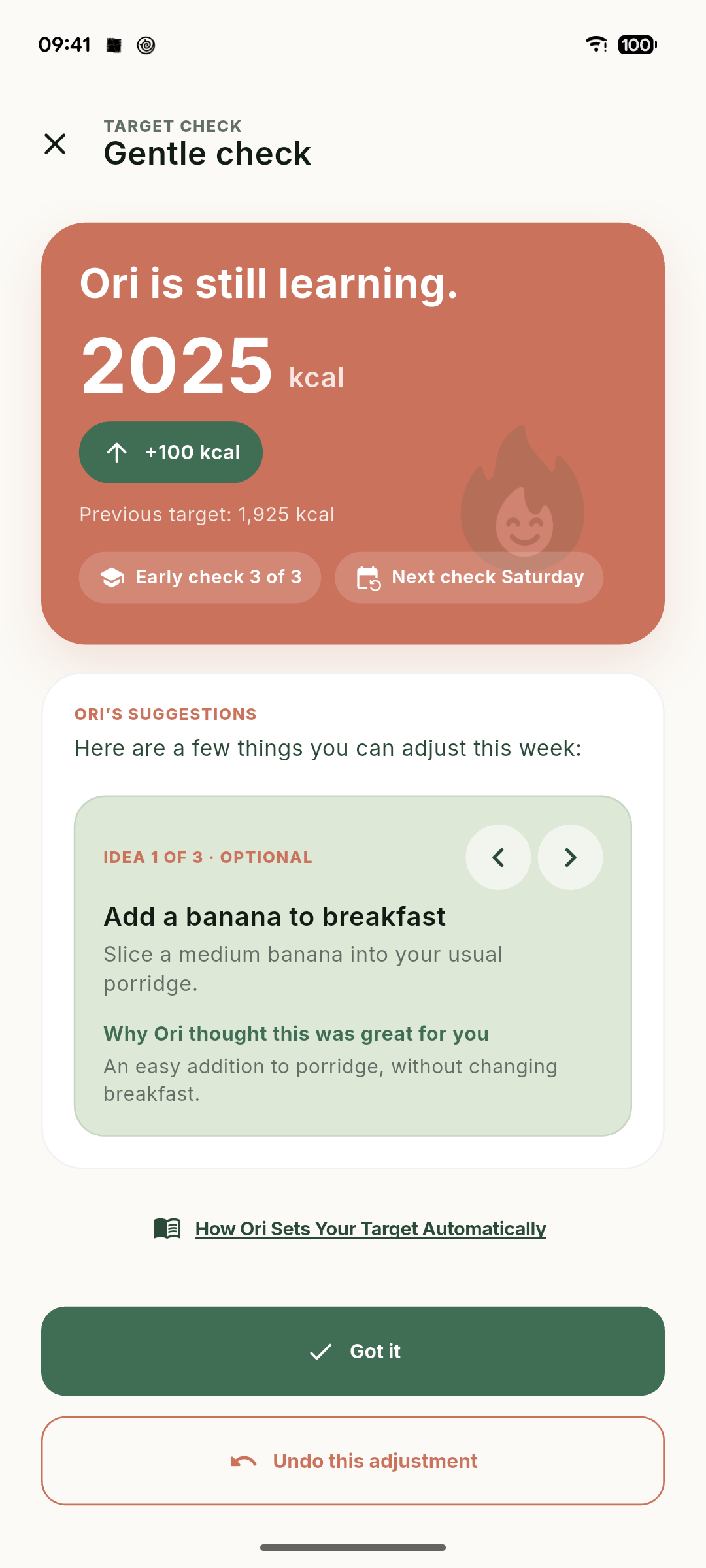
Then multiply that by a number for how active you are, from the table below. These are the activity numbers most calculators use, and the same ones the Ori app uses to set your first target. The answer is an estimate, not a measurement.
Here's an example. A 35-year-old woman who is 165 cm tall and weighs 70 kg burns about 1,400 calories a day at rest. If she does moderate exercise 3 to 5 days a week, multiply by 1.55. Her maintenance is about 2,150 calories a day.
What is the difference between BMR, TDEE and maintenance calories?
BMR is what your body burns at rest, just to keep you alive. TDEE means total daily energy expenditure: everything you burn in a day, including moving about and exercise. Your maintenance calories are the same as your TDEE. If you eat that amount, your weight stays roughly the same.
Which activity level should I pick?
Pick the one that sounds most like a normal week for you. If you're torn between two, pick the lower one for now. Your weight trend over the next few weeks will tell you if it was right.
| Activity level | Sounds like | Multiply by |
|---|---|---|
| Sedentary | Desk job, little to no exercise | 1.2 |
| Lightly active | Light exercise 1 to 3 days a week | 1.375 |
| Moderately active | Moderate exercise 3 to 5 days a week | 1.55 |
| Very active | Hard exercise 6 to 7 days a week | 1.725 |
| Extremely active | Very hard exercise plus a physical job | 1.9 |
How accurate is a maintenance calorie calculator?
It's a good first guess, but it can be out for you. A 2005 review found Mifflin-St Jeor was the most reliable of four common formulas, but it can still be more than 10% out for some people. On a 2,000 calorie estimate, 10% is 200 calories. The activity level you pick adds more guesswork. That's why we show a range of 10% either side, instead of one exact number.
How do I find my real maintenance calories?
Use your weight trend. It takes a few weeks, but it's the simplest way to get your own number.
- Eat around your estimate for three or four weeks, and log what you eat.
- Weigh yourself a few times a week and compare weekly averages, not single days.
- If your average stays flat, you've found it. If it drifts down, your maintenance is a bit higher. If it drifts up, it's a bit lower.
If logging or weighing this closely feels stressful, you don't have to. A rough idea is fine, and a GP or dietitian can help you work out what suits you.
Daily weight swings can hide small changes, which is why the weekly average matters. Our guide on why your weight fluctuates so much explains this, and our guide on how to find your maintenance calories goes through it step by step. If you'd rather not do the checking yourself, Ori Premium checks your logs and weight trend each week and updates your target.
How many calories should I eat to lose or gain weight?
To lose weight, eat a little less than your maintenance. Our calorie deficit calculator works out a daily target for you, at a pace you choose, using the same maths as the Ori app. Very low targets aren't a good idea without support, so read is 1,200 calories a day too little before going that low.
To gain weight, eat a little more than your maintenance. Our weight gain calorie calculator works out a daily target at a pace you choose, using the same maths as the Ori app. The NHS suggests adults could add around 300 to 500 calories a day and gain gradually. The app starts a little lower and adjusts from there. Our guide to apps for gaining weight may help too.
Who shouldn't use this calculator?
It's for adults. The formula was built from people aged 19 to 78, so it's less tested outside that range. If you're under 18, pregnant or breastfeeding, have a medical condition that affects your weight, or have or have had an eating disorder, please speak to your GP or a dietitian instead.
A gentle safety note
This calculator gives a general estimate for healthy adults. It is not medical advice. Ori supports general wellness and is not medical care.
Read Ori's Health DisclaimerSources
- Mifflin MD, St Jeor ST, et al. A new predictive equation for resting energy expenditure in healthy individuals. American Journal of Clinical Nutrition, 1990.
- Frankenfield D, Roth-Yousey L, Compher C. Comparison of predictive equations for resting metabolic rate in healthy nonobese and obese adults: a systematic review. Journal of the American Dietetic Association, 2005.
- NHS Better Health. Calorie counting (checked 19 October 2026).
- NHS. Healthy ways to gain weight (checked 19 October 2026).