


A calorie deficit means eating fewer calories than your body uses, so it draws on stored energy and you lose weight. This calculator works out your maintenance calories, then takes off a small amount based on how fast you want to lose weight.
How do you calculate a calorie deficit?
It takes three steps.
- Work out your maintenance calories: what you burn in a day. Our maintenance calorie calculator shows how.
- Pick a pace. A rough rule says a kilo of body fat holds about 7,700 calories. So losing 0.25 kg a week needs about 275 fewer calories a day (0.25 × 7,700 ÷ 7).
- Take that off your maintenance. We start a little gentler, at about 250 for that pace, the same as the Ori app. A target that's slightly too generous is easier to stick to than one that's slightly too strict.
Here's an example. A 35-year-old woman who is 165 cm tall, weighs 70 kg and exercises 3 to 5 days a week has a maintenance of about 2,150 calories a day. At the steady pace, she'd eat about 1,900.
The 7,700 rule is only a guide. A 2008 study found it fits people with more body fat fairly well, but leaner people need a smaller deficit than the rule says for each kilo they lose.
What should my calorie deficit be?
For most people, about 150 to 500 calories a day below maintenance. That works out at roughly 0.15 to 0.5 kg a week. For people living with obesity, the NHS suggests aiming to lose 0.5 to 1 kg a week. The Ori app keeps to 0.5 kg a week or less, and so does this calculator.
A bigger deficit can bring more hunger and tiredness, which makes it harder to keep going. We cover the signs your deficit is too big in is it normal to be hungry in a calorie deficit and why am I so tired in a calorie deficit.
How many calories should I eat to lose weight?
At our steady to fastest paces, that's about 250 to 500 calories a day below your maintenance. The NHS says women use around 2,000 calories a day, and men around 2,500. Using those figures, that's roughly 1,500 to 1,750 a day for women and 2,000 to 2,250 for men. Your own number depends on your size and how active you are. Its calorie-counting advice suggests cutting around 600 calories a day. By the 7,700 rule, that's a little over 0.5 kg a week, close to our fastest pace.
Don't go to 1,200 calories a day or below without support. Our guide on whether 1,200 calories is enough explains why.
Why does my calorie deficit stop working?
Because your body changes. A lighter body needs less food, so a target that worked at the start slowly turns into maintenance. Your everyday movement can drop a little too. We explain this in weight loss plateau: why has it stopped?
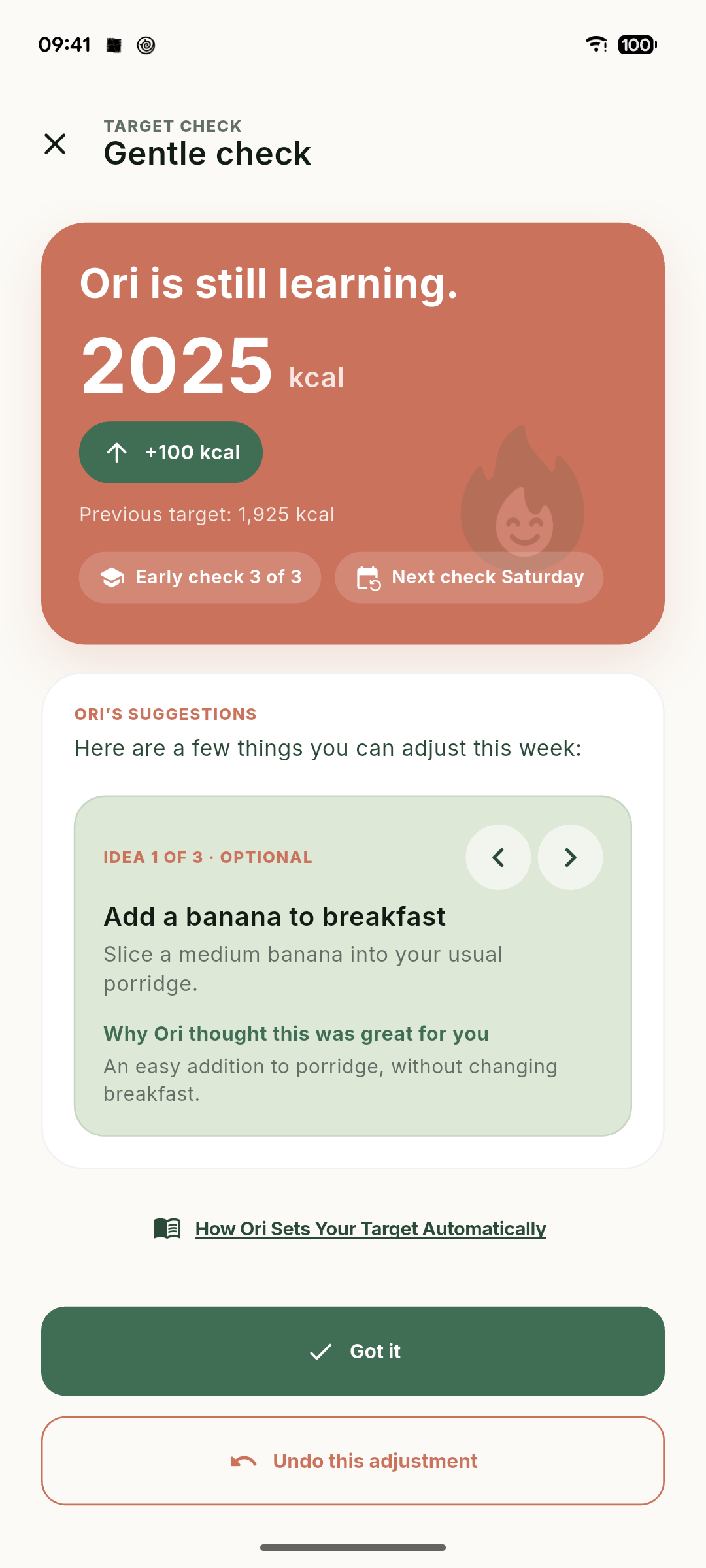
The fix is to check your target every few weeks against your weight trend, and lower it a little when progress stalls. If you'd rather not do that yourself, Ori Premium does it each week.
How long before I see results?
Usually a few weeks. Your weight goes up and down every day with water, salt and food, which can hide small losses. Compare weekly averages, not single days. Our guide on how long a calorie deficit takes to show results goes through what to expect.
Who shouldn't use this calculator?
It's for adults. If you're under 18, pregnant or breastfeeding, have a medical condition that affects your weight, or have or have had an eating disorder, please speak to your GP or a dietitian instead. If your weight is already low for your height, the calculator won't suggest a target.
A gentle safety note
This calculator gives a general estimate for healthy adults. It is not medical advice. Ori supports general wellness and is not medical care.
Read Ori's Health DisclaimerSources
- Mifflin MD, St Jeor ST, et al. A new predictive equation for resting energy expenditure in healthy individuals. American Journal of Clinical Nutrition, 1990.
- Hall KD. What is the required energy deficit per unit weight loss? International Journal of Obesity, 2008.
- NHS. Obesity: treatment (checked 20 October 2026).
- NHS Better Health. Calorie counting (checked 20 October 2026).